Please mention SP13 ‘Land at Meadow Lane’ (changed from ‘SP42’ in the earlier Local Plan 2036)] Feel free to draw on our main points of objection, summarised below:
Conservation Area status Any development of Land at Meadow Lane fails to conserve and protect the ‘strong rural characteristics’ identified as a key feature in the Iffley Conservation Area Appraisal (2009) and will deliver very substantial harm to these assets.
County Council Principal Quiet Route Church Way and Meadow Lane are part of the designated Principal Quiet Route OXR 18, heavily used for leisure and active travel by cyclists, joggers, walkers, families with prams, mobility scooters, and horse-riders. This fact seems to have been missing from the allocation as presented to the Inspector for LP2036. Any development of ‘Land at Meadow Lane’ fails to take into account the substantial harm that increased vehicular traffic will have on the Quiet Route at a time when OCC policy is to increase active travel and reduce congestion, air pollution and carbon emissions. Increased traffic around the village is a major concern.
Ecology The HF ‘easily meet the criteria to be classified as an Oxford City Wildlife Site’ (Bioscan). The fields were allocated in LP2036 on the basis of a cursory look over the gate with no proper ecological survey. The site includes a large, active badger sett and the fields are foraging grounds. This is a protected species and should have been mentioned in any ecological assessment prior to allocation. We are very concerned that OCC allows such inadequate assessment to form the basis of decision-making with an irreversible impact on our environment.
Flood Risk and Drainage In the light of climate change, OCC should not allow any development within Flood Zones 3a or 3b, except in wholly exceptional circumstances. FOIV remains deeply concerned about the proposal to build 30+ houses on the last remaining acres in the Iffley Conservation Area. It is felt that there was insufficient consultation about the original allocation plans, and that many local people including those on Meadow Lane, had no idea what was being proposed. We note that for the HF application there were over 1,000 formal responses on the City’s Planning portal – a huge number – with some 98% of those objecting to it, including from statutory consultees such as the Environment Agency; plus BBOWT; Buglife; Windrush Against Sewage Pollution; Cotswolds Rivers Trust; CPRE Oxfordshire; Cyclox; Oxford Badger Group; Iffley Fields Residents Association; Oxford Rivers Improvement Campaign; Oxford Civic Society; Oxford Pedestrians Association; Oxford Urban Wildlife Group; plus a Holding Objection from Thames Valley Police. We fundamentally oppose the principle of building on this site since it does not comply either with SP42 [now SP13] or the Council’s development plans as a whole. This site is not suitable for development. The draft LP 2040 is simply repeating the same policy, based on the same erroneous assessment. We expect OCC to take notice of the huge opposition to the HF proposal, and an alternative vision – such as a nature school – to be acted upon or at least taken into consideration. Since OCC owns this site, there is no excuse for not applying the core principles in LP2040 of addressing the climate emergency, promoting green transport/cycling infrastructure. The need for affordable, social rent housing can be met on nearby Iffley Mead, another publicly owned site, which is also allocated for development (SP14 in LP2040). In response to OxPlace’s December 2022 application, FOIV engaged experts in five key areas: Heritage/Conservation (Orion Heritage); Landscape/Environment (Alison Farmer Associates); Ecology/Biodiversity (Bioscan Ltd); Transport/Traffic (Velocity); Drainage/Flooding (Water Resource Associates); plus Mark Wood Associates, by crowdfunding, on Planning. The experts concluded that the application should be rejected, and the Planning office sent it back for thorough revisions. We await OxPlace’s revised application and have retained the experts to review the re-submitted documents. An independent Crowd Funder will be set up to invite donations to pay the experts.
FOIV appreciates the opportunity to provide our views at this stage in order to inform any potential development on this site, mindful of the considerable challenges it poses for any development. Below are some of the key issues for consideration:
FOIV recognizes the need for social and truly affordable housing, and thinks that development of the Iffley Mead site could go towards mitigating this need since in our view any development on public lands should target provision of affordable housing. In particular it could provide housing for key workers for both the County and the City, and FOIV would support that as a key design objective. FOIV suggests that 100% affordable should be the target and if not, then full justification for its lack or shortfall would need to be demonstrated at outline stage. It should be remembered that this is public land even though vested in the County Council as ‘owner’, and should be used for the public good.
The development of this site should be seen in a wider context, and the scope for it to relieve development pressure on other far less suitable (or unsuitable) – such as the Horse Fields in Iffley (SP42) – should also be a design driver.
To that end, FOIV suggests that the City and County Councils think holistically about all the proposed developments in this area. If the whole area were under a single authority, a scheme might emerge which would minimise the harm done to all the interests in the locality. The Iffley Mead site presents an ideal opportunity for such ground-breaking collaboration and FOIV will be looking for signs of such cross-thinking.
FOIV believes that a fruitful collaboration of the County and City would make this proposal much better. We suggest that the 30 affordable homes planned for the Horse Fields could be accommodated on the Iffley Mead site to help address the acute need for affordable homes, but also to avoid permanent destruction of the Iffley Conservation Area, wherein the Horse Fields lie, and their importance as a nature site.
Such a scheme could evolve if the Iffley Mead land were owned by a community land trust, such as the Oxfordshire Community Land Trust. This would provide truly affordable housing for the key workers and staff that councils are finding difficult to recruit in Oxford. The cornerstone of their model is that any housing they build can remain for rental at affordable rates in perpetuity as it is not subject to right to buy.
FOIV is aware that this consultation is being undertaken in order to attach conditions to the sale of the Mead to a developer, and that any purchaser will be able to alter the illustrative scheme in their final planning submission. FOIV’s submission therefore concentrates on issues which could result in binding parameters and conditions being set at outline stage. There are several very obvious problems and constraints with the site: among them, the access, and the disposal of waste water.
The problem of access through Augustine Way caused the last FOIV Committee to consider the scheme unsound altogether.
Regarding water use, the development needs to demonstrate, even at outline stage, how Thames Water’s requirement for consumption of 110L ppd is to be met. Additionally, there will need to be clear and binding parameters set show how the scheme will cope with the pressure from the residents’ usage and run-off on the infrastructure for surface water and foul drain. In particular, to demonstrate how the site will connect to the local foul sewer network and how it ensure that there will be no sewage- and surface-pollution of the river from the scheme, given the current lack of capacity of Sewage Treatment Works to process existing foul/waste water; as well as demonstrating that there will be no pollution from these sources to Iffley Meadows SSSI opposite and downstream, recognising that the drainage system that flows through the foot of Meadow lane, by the Horse Fields and crosses properties abutting the Thames through Iffley Village.
The site will also need to demonstrate how it will achieve a 10% net gain in biodiversity given that this will be a mandatory requirement by the time of any application. This will require high quality and robust ecological survey information to avoid the errors and omissions that have affected other applications locally in relation to this issue.
There is a LP-recognised wild-life corridor that crosses the present site, used by badgers, bats and other species and this should be safeguarded. As we know, light pollution is damaging for nocturnal creatures – especially given increased lighting everywhere. Thought should be given to the lighting design to keep light pollution in check, for example using movement-triggered systems, low wattage lighting, careful placement and so on.
FOIV strongly endorses the proposal to plant additional appropriate trees at all the boundaries of the present site (on the understanding that planting saplings not become an excuse for cutting down mature trees), and the need to ensure the protection and enhancement of biodiversity in accordance with local and national planning policy.In a related way, FOIV also strongly objects to the proposed unnecessary cutting down of trees in the Meadow Lane copse to make way for a cycle path exit on to Meadow Lane. Mature trees should be preserved at all costs on this and surrounding sites.
The height of the buildings should avoid any reduction of amenity to the school and other properties adjoining the site. Green spaces, vegetation and trees are essential also.
FOIV understands the proposal that any scheme should be car-free, but there is a disconnect between what this term means in the ‘real’ world and what it means to City and County transport/parking planners. Given the near certainty that it would likely mean new residents choosing to park in nearby areas, rather than not have a car, this would certainly reinforce the idea of a CPZ for the surrounding streets, which are already very congested. It is highly unlikely that residents would not own cars.
There are concerns over the way that facilities and amenities are described. The bus services are not good at present, and not everyone can or wishes to participate in ‘active travel’, especially when the weather is inclement. The trip to the railway station currently involves changing buses, and is not quick. The nearest shops are a good distance away, and the local GP surgery may not even know about this proposed increase to its patient intake; ditto the dental practice.
Please acknowledge receipt of this response, which we are sending via our County Councillor Brad Baines since the survey consultation document was not suitable for our submission.
The affordable housing would be better delivered nearby on Iffley Mead: The proposed provision of 32 affordable homes can be met nearby at the Iffley Mead allocated site by increasing the amount of affordable housing built there and reducing the proportion of housing built for profit. This site can support denser housing as it lies outside the Conservation Area. This is a clear, proximal and more sustainably sited alternative for the proposed housing provision, with much lower environmental impact on the meadows and quiet route. The question of such alternatives has not even been considered in the application, despite the established policy requirement to avoid environmental harm where possible.
The suggestion that a higher proportion of affordable housing could be met at Iffley Mead is not a suggestion that the numbers of houses proposed at Iffley Mead ought to be increased. It is a suggestion that the proportion of those houses given over to what the Council calls ‘affordable’ tenure types (ie shared ownership and social rent) might be increased from the current figure of 50%. This would require the City Council and the County Council to work together for the common good, including protecting the biodiversity and public benefits of keeping the Horse Fields and Memorial Field undeveloped. As the City Council have felt able to propose 100% affordable at the Horse Fields there would appear to be no basis for suggestions that greater than 50% at Iffley Mead is ‘unviable’. We are looking to the City and County to adopt a joined up approach to land use planning in accordance with their obligations under law and planning to seek the least environmentally damaging options for delivery of housing.
As you know, this application is now live; deadline is 10th February. We have compiled some pointers for those who wish to object to this application in the Iffley Conservation Area. We are well aware that some members do not support this stance, and of course they can make their views known to the planners also.
Horse Fields – as they areand as they may become…
PROPOSED DEVELOPMENT OF THE HORSE FIELDS AND MEMORIAL FIELD, IFFLEY VILLAGE – TIME TO LET THE COUNCIL KNOW HOW YOU FEEL!
The long-anticipated planning application for the Horse Fields development (reference 22/03078/FUL) has been made. For those who want to object to or otherwise comment on this application, the clock is now ticking. The City Council has indicated a deadline for receipt of comments of 10th February.
A step-by-step guide on how to make comments on the application is provided at the end of this note.
ELEVEN KEY ISSUES AND CONCERNS TO RAISE WITH OXFORD CITY COUNCIL
An initial review of the application plans and documents by Friends of Iffley Village (FOIV) committee has identified the following immediate concerns about the application[1]. FOIV committee believes that this review already vindicates concerns that this site has never been suitable for development and consequently that the proposals represent unsustainable development that does not comply with planning policy. They urge members to object and to encourage others to do so, either by filling in the on-line form on the Council’s website (see attached instructions), or by e-mailing their reasons for objection to the case officer Michael Kemp at MKEMP@oxford.gov.uk
1. Harm to the Iffley Conservation Area: This is a greenfield site that makes an essential contribution to the integrity and setting of the designated Iffley Conservation Area and which is critical to the retained rural character of the village. These meadows are as unique as other irreplaceable heritage assets in the city that no one would dream of building on. The developers themselves acknowledge that there will be significant harm to the Conservation Area, and to the local landscape setting. The proposed widening of Meadow Lane will create a suburban access road, thus losing the distinctive ‘rural quality’ of the lane valued in the Conservation Area Appraisal. The addition of pavements, changes to the Church Way gate entrance and the junction of Meadow Lane and Church Way will further suburbanise these lanes, harming the rural character of Iffley.
2. The affordable housing would be better delivered nearby on Iffley Mead: The proposed provision of affordable housing can be met nearby at the Iffley Mead allocated site by increasing the amount of affordable housing built there and reducing the proportion of housing built for profit there. This is a clear, proximal and more sustainably sited alternative for the proposed housing provision, with much lower environmental impact. The question of such alternatives has not even been considered in the application, despite the established policy requirement to avoid environmental harm where possible.
3. Road access, traffic and conflict between vehicles and other users of the Meadow Lane ‘Quiet Route’. Development of the Meadow Lane/Horse Fields site would generate significant traffic and parking problems along Meadow Lane and spilling into surrounding areas, both during construction and after completion. Amongst other things, this will significantly degrade the attractiveness, safety, tranquillity and use of the County Council’s own designated ‘Quiet Route’ (OXR18) along Meadow Lane which is intended to protect this sustainable pedestrian and cycle link between Iffley Village, Rose Hill and Littlemore into the City. The Quiet Route is used by thousands of walkers, joggers, cyclists, horse riders and disabled users as a car-free route into east Oxford or further into town, or as part of the much loved ‘Iffley Loop’ walk. A significant length of this Quiet Route will be urbanised, opened-up to increased volumes of motorised traffic and reconfigured to allow two-way use, destroying its tranquillity, safety and character as noted earlier.
4. Parking and highway safety: The proposed development proposes too few parking spaces for the cars it will generate: less than a 1:1 car parking ratio, with only 17 spaces, unallocated except for 2 houses off Church Way, for 32 homes and an estimated 161 people. Overspill parking along Meadow Lane outside the development will present a hazard for two-way traffic, likely requiring widening, loss of vegetation and highways improvements that will further urbanise the route and harm the conservation area. The junction between Meadow Lane and Church Way is already hazardous and not suitable to take the additional volume of traffic, potentially entailing further urbanising works and signage. A cycle path would decant cyclists through the development onto a busy blind corner on Church Way. The National Planning Policy Framework states that ‘development should only be prevented or refused on highways grounds if there would be an unacceptable impact on highway safety, or the residual cumulative impacts on the road network would be severe.’ This is clearly the case in these proposals.
5. Unsustainable location: The application suggests that it encourages the new occupants to prefer sustainable transport modes, but the development is not in a sustainable location, being further from schools, bus stops and supermarkets than the Council’s own policies recommend. Use of sustainable modes will be further discouraged by the harm to the tranquillity, safety and attractiveness of the Meadow Lane Quiet Route. These factors will simply encourage increased car ownership and use, not reduce it.
6. Loss of wildlife/biodiversity: The applicant acknowledges that there will be significant loss of biodiversity locally due to the development. Its own ecology surveys, and those commissioned by FOIV, show this to be a site with high biodiversity value, consistent with its position at the junction of several wildlife corridors. As well as a resident badger population, including a rare white badger (‘Luna’), the site is acknowledged by the applicant as being of ‘county importance’ for invertebrates and to support other protected species. It is the only known site in the City for no less than 9 species of rare bees, beetles and moths, and many of these are also very rare in Oxfordshire generally, and of high conservation importance nationally. The applicant has failed to recognise that the land comfortably meets the criteria for designation and protection as a City Wildlife Site. In part this is because the applicant’s wildlife surveys are deficient and missed important species, including protected species such as grass snakes and bats. In fact, no bat activity surveys were done at all, and consequently the presence of the rare barbastelle bat was completely missed. We don’t yet know exactly what they propose to do with the badgers as full details have not been provided, but they cannot survive within a development site.
7. Displacement of biodiversity: The applicant admits that the development will cause ‘net loss of biodiversity’ and that this means it fails national policy tests. It proposes to pay sums of public money into a pot for habitat creation to offset this somewhere else in Oxfordshire. No detail is provided about this. ‘Exporting’ biodiversity outside the City to make room for development degrades the City environment, is poor and irresponsible practice and does not comply with relevant guidance and policy.
8. Ecosystem services: The Council has undertaken no assessment of the ecosystem services the site provides in its present state. As public land, local people think it should be made available for use for education and appreciation of its wildlife value. Local people have created an alternative vision of a Meadow School which local schools say would meet a defined need and which is much more in keeping with the Council’s own policies for access to and contact with nature and the wellbeing and societal benefits that this generates, as well as protecting carbon stored in soils and trees and helping to prevent flooding.
9. Drainage, flooding and sewage: The surface water drainage design proposed for the development is straight out of the 1970s with almost everything piped and stored underground. This is no longer an acceptable approach to sustainable management of surface water and increases the risk of flood risk and pollution due to system failure. Oxford Sewage Treatment Works is already c.39% under-capacity and OxPlace has failed to secure commitments that it can safely process additional waste water from161 residents. This puts further pressure on Oxford Sewage Treatment Works, adding to system overload and more raw sewage releases into the river. Please object to this archaic and non-sustainable approach. We hope and expect the Environment Agency will object to this archaic and non-sustainable approach.
10. Broken promises on Memorial Field: The Council’s proposals for Memorial Field are unclear. The Council has long promised that Memorial Field will remain undeveloped and preserved, but there are various references to proposals for landscaping and amenity use, and use as open space. Using Memorial Field to deliver landscaping and amenity space means that it is being treated as part of the development site, breaking the Council’s promise. These uses are contradictory and generate practical challenges that have not been considered at all.
11. Poor design standards and error-strewn documents and plans: Overall, the application is poorly put together and contradictory in many respects. It refers to the location as ‘Iffley ward’ which does not exist. Some reports use out of date plans, and other reports are missing. Photos are incorrectly labelled. It seems rushed and disjointed. The architectural design is a departure from what was previously proposed and uses incongruous materials, increased density of housing and reduced provision of green space, increasing the harm to the conservation area.If you agree with FOIV committee that this is a wholly inappropriate, unsustainable and ill-conceived development proposal, please feel free to amend and use any (or all) of the above eleven reasons why it should be refused permission and/or add your own reasons. Submissions in your own words are best, but cut and paste submissions are better than not making your voice heard at all! Remember: your comments should be received by the Council no later than 10th February.
The next section gives step by step instructions on how to make your comments on the application.
TO OBJECT OR MAKE OTHER COMMENTS ON THE APPLICATION, YOU CAN WRITE VIA E-MAIL OR POST TO THE CASE OFFICER, MICHAEL KEMP OR YOU CAN DO SO ONLINE.
1. BY E-MAIL OR POST
The e-mail address is MKemp@oxford.gov.uk and you should include the planning reference 22/03078/FUL in your correspondence. The postal address is:FAO: Mr Michael Kemp Planning and Regulatory Services Oxford City Council St Aldate’s Chambers 109-113 St Aldate’s Oxford OX1 1DS
2. ONLINE
STEP BY STEP INSTRUCTIONS FOR HOW TO SUBMIT AN OBJECTION OR OTHER COMMENTS ONLINE:
1. Got to www.oxford.gov.uk and this page (below) should open. Click on ‘planning’ (circled yellow at the bottom left below)
2. The next page you will see is this one (below). Click on ‘Planning Applications’) in the top left of the menu (circled yellow below)
3. The next page you will see should be this one (below). Click on ‘view and comment on planning applications’ (again circled yellow below):
4. This takes you to this page (below). Click on the big green/turquoise tab saying ‘view and comment on planning applications’ (again circled yellow below).
5. This takes you to his page (below). Insert the planning reference 22/03078/FUL into the space circled yellow below and then click on the blue ‘search’ button to the right of it.
6. The next page you see (it might take a few seconds) will be this one (below). If you want to look at the plans and reports submitted by the developer OxPlace and/or the comments other people have written, you should click on the ‘documents’ tab (circled yellow) which takes you to a list of files which you can click on to download (NB if you leave this open and inactive you will get logged out after some minutes and have to log back in again).When you are ready to make your on-line comment, click on ‘make a comment’ (circled red)
7. The ‘make a comment’ page (below) allows you to enter your name and address (this is necessary) and to register objection, support or neutrality, and to give reasons from a checklist and to scroll down to provide a written comment. It is a good idea to write your comment on a separate file (e.g. in a MS Word document) and cut and paste it into the comment box as otherwise it is easy for you to be timed out and to lose what you have written.
[1] FOIV committee also has professional consultants working on reviewing the application submission and we anticipate that more issues (and more detail on these eleven key issues) will emerge in the coming weeks. FOIV will keep people updated on developments via notices, e-mail drops and social media. Please note that you can make more than one submission to the Council – for example if you think of something you forgot to say after you’ve objected, or agree with something that emerges later.
From Oxford City Council: consulting on the Oxford Local Plan 2040 Preferred Options document. The Local Plan 2040 will set out the planning strategy for meeting the needs of the city and once adopted, will be used in determining planning applications for a wide range of development. It will guide how development happens, helping to support the transition towards a zero carbon city, ensuring high quality design, being conscious of health and wellbeing, and addressing inequalities.
Last summer [the Council] asked you what issues the new Local Plan should cover. [The Council] have listened to what local communities, businesses and other organisations told them and are now considering a range of policy options. The Preferred Options document gives you the chance to comment on the proposed approaches to a range of issues. The consultation period runs from 3rd October 2022 until the 14th November 2022.
OCC website (www.oxford.gov.uk/localplan2040) have published the main Preferred Options document, background papers and studies on key issues, and a draft sustainability appraisal. Comments on these documents can be submitted online, using the consultation portal, found here:https://consultation.oxford.gov.uk/. There is the opportunity to respond to the main document using our detailed online questionnaire, or to complete the shorter online questionnaire. If you prefer to respond in writing or email, please email planningpolicy@oxford.gov.uk.
Paper copies of the main Preferred Options document are available to view in libraries.
The planning policy team will be at a number of locations across Oxford, throughout the consultation period, where people can come and chat to us. Details are available on the website: www.oxford.gov.uk/localplan2040
Comment on the new construction at Court Place and Gardens from Friends of Iffley Village (FOIV)
People have lived and farmed in Rose Hill and Iffley for thousands of years. Court Place takes its name from the mediaeval Manorial Court on this site built next to the universally admired Romanesque church of St Mary the Virgin (c.1160). With all the land owned by The Poor Men of Donnington and bordered by then unspoiled meadows and fields, Court Place encompassed the legal, spiritual and economic centre of Iffley, Rose Hill and Littlemore.
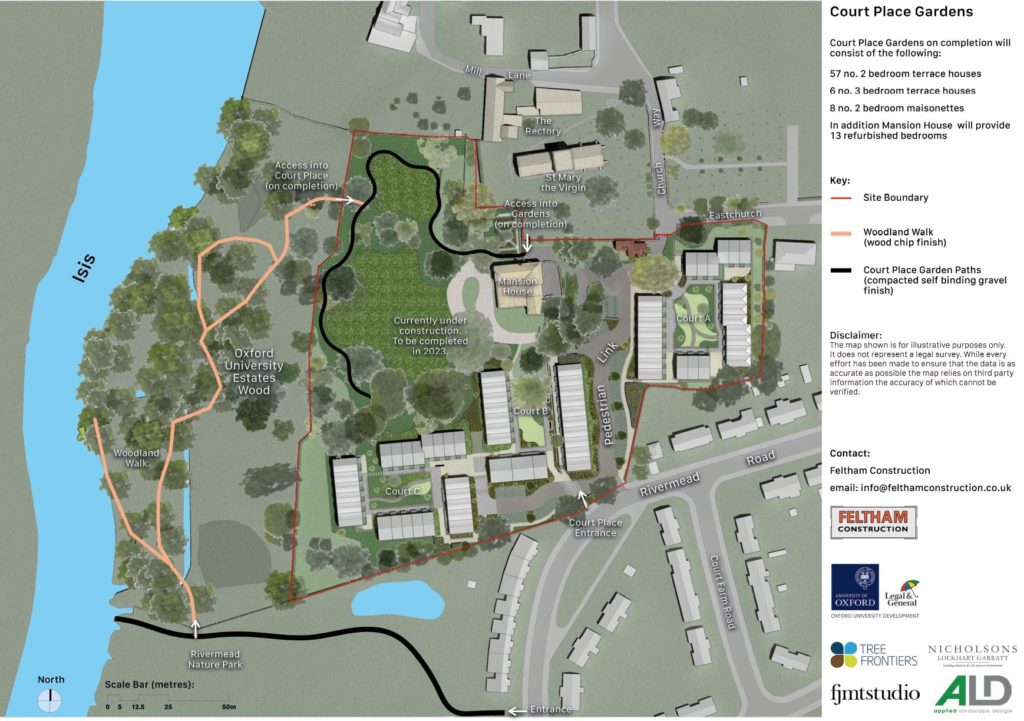
Court Place has long attracted generations of distinguished tenants and self-absorbed undergraduates, church-crawlers, moody poets, dogwalkers, courting couples, at least one saint (Saint John Henry Newman) and authors galore eg The Revd Charles Dodgson (Lewis Carroll). Then in the 1960s, the University began encouraging post-graduates who brought with them, families! A modest range of asbestos-infested houses was built which are now being demolished in favour of pan-collegiate family housing development by Oxford University Developments (OUD), a joint venture between the University and Legal & General; all within an enhanced landscape including all-ages, all-ability pathways both within Court Place Gardens and Oxford University Woods. Please see the map.
With the community’s interest at heart, FOIV has been involved from the beginning with OUD and Legal & General to ensure the new Court Place will be sympathetic to its setting. We are now working with the constructor Feltham to ensure the impact of the work is minimised and a legacy for our community. Feltham has committed to exceeding the minimum conformance standards in the Considerate Contractor Scheme, Peter McCarthy (peter.mccarthy@feltham.construction.co.uk) is our primary point of contact.
Troth Wells Chair, FOIV July 2022
On your behalf, FOIV is responsible for preserving, conserving and enhancing the quality of life where we live, from providing welcome packs to overseeing planning and traffic issues. Join us at friendsofiffley.org. For any traffic or planning issues contact Phil Hart at planning@friendsofiffley.org. Contact FixMyStreet.com to get action on road issues.
Court Place: a lasting legacy – Current status reports by Oxford University Asset and Space Management and Nicholson:Lockhart Garrett
Residents are very aware of the disruption and permanent harm new building – and intended new building – can have on our increasingly fragile eco-balance. At Court Place, Oxford University Developments is seeking to enhance the quality of the new housing project in two specific ways:
First, by increasing the range of plants and animals found in the Rivermead Nature Park and OU woodlands, by removing low-quality trees and shrubs to give new, better specimens more room to grow and let more light reach the ground, encouraging natural regeneration of young trees as well as providing visitors with a new, all-weather woodland path (see map). This work is being done under the leadership of Iain Critchlow, the University’s Director of Asset and Space Management. Quality trees within Court Place Gardens are being retained and protected to ensure there will be no damage to existing root systems. A new planting scheme will encourage biodiversity through the use of species rich grassland mixes, native shrub and tree planting.
Secondly and equally important, ecological survey work has been ongoing at Court Place Gardens by Nicholson:Lockhart Garratt since 2017, led by Jo Alderton, including habitat surveys, water sampling for newt eDNA and badger surveys. In relation to bats we have inspected every tree in Court Place for potential bat roosting along with daytime and nocturnal surveys of the buildings. Feltham Construction is working to ensure no bats are harmed during the demolition/construction phases and roosting features for bats, swifts and owls will be integrated into the new buildings.
Acknowledgement
FOIV thanks Feltham Construction for sponsoring this insert into the Iffley Parish Magazine as part of their community outreach programme.
Friends of Iffley Village Comments on OCHL’s second public consultation.
Friends of Iffley Village (FOIV) is the residents’ group for anyone who lives in Iffley or has an association with the village. The organisation is run by its management committee, which deals with matters arising such as proposed developments, parking, and other local issues. It also organises events during the year. Although it has no formal role in connection with the Oxford City Council, it is usually consulted in matters relating to planning decisions. In a recent survey of its membership (currently 361 members), 78% of respondents were in favour of keeping the Horse Fields green, and 81% said that the proposed development would have a negative impact on the Quiet Route.
We offer the comments below without prejudice to our position that we are opposed to the proposed development of the Horse Fields (‘Land off Meadow Lane’, SP42), and indeed that failures in the site allocation process mean that they should not have been allocated in the first place.
Key areas of local concern:
1. Ecology and biodiversity
2. Conservation Area: rural characteristics, open space, green infrastructure
3. Traffic and parking
4. Quiet Route: cycling, pedestrians, equestrians
5. Flood risk and drainage
6. Design
7. Lack of accuracy and coherence in public communication and consultation
1.1 We agree with the statement on p. 10 of the printed material that ‘the existing ecology and landscaping is key’; however the information provided does not indicate how this development would protect or enhance existing ecology and landscape values. As indicated on the Masterplan (p. 5), the siting of access road, footpaths, and substantial gardens indicate minimal concern for the site’s existing ecology.
1.2 We are concerned about the ecology and habitats found on the two fields themselves, and not just the boundaries (hedgerow on Meadow Lane and stone wall on Church Way). We look forward to reading your analysis of the ecology of the site and precisely how you propose to achieve a biodiversity net gain of 10% in line with the Environment Act 2021 on the Horse Fields as net loss presently appears more likely. We anticipate further studies of the potential impacts on the nearby SSSI, as required by the Local Plan. This should include demonstration of how the development will achieve, in isolation and cumulatively, a nutrient neutral position in order to avoid exacerbating nitrogen and phosphate pollution on Iffley Meadows SSSI or other downstream flood meadows.
1.3 We look forward to understanding how you propose to protect the wildlife living on the Horse Fields and the wildlife corridors to adjacent green and blue spaces. We have yet to be convinced that you have conducted adequate surveys for all likely protected species, and have fully considered the implications of the loss of their habitat and foraging areas.
1.4 We remain deeply concerned about the safety of the large, resident badger population in these fields. Inconsistent responses from the OCHL team, as well as the indicative design, has only intensified our concern for their future. As well as threat to the sett, no regard appears to have been had for their foraging requirements.
1.5 We question why Memorial Field is being included in this development proposal (p. 11), not being part of the allocation SP42? Urgent clarity is sought on this point. If there is an intention to appropriate Memorial Field for delivery of open space, biodiversity and other elements then we consider this will not be compliant with the Local Plan. If, alternatively, proposals for Memorial Field are purely enhancement (i.e. not mitigation or compensation) then far greater information is needed in order to reflect on a management plan for Memorial Field.
2. Conservation Area: rural characteristics, open space, green infrastructure
2.1 The development appears inconsistent with the ‘sensitive infill’ recommended in the Local Plan. The proposed natural areas and community open spaces appear extremely small in relation to the built environment.
2.2 The proposed development fails to conserve and protect the ‘strong rural characteristics’ identified as a key feature in the Iffley Conservation Area Appraisal (2009) and in fact will deliver very substantial harm to these assets. These last remaining open fields are what preserve the unique, rural character of Iffley described in the ICA. This harm applies to views into and out of the ICA as well as the integral fabric of the ICA itself.
2.3 The lower half of Meadow Lane, with its grass verges and intermittent open views through the established hedgerow, currently retains the feel of a rural country lane, deriving from its historical, medieval origins as a drover’s lane. This will be lost to the detriment of the ICA.
2.4 The Horse Fields gate on Church Way provides the first open green views for pedestrians approaching the village from Iffley Turn, and down the hill from Tree Lane. These views, towards the river and undeveloped floodplain, are key to maintaining the essentially still rural setting of the village and by extension the integrity of the ICA. The current design proposes four houses that will entirely block these existing rural views as well as the associated wildlife corridor.
2.5 Equally, there is no consideration of substantial harm that will be caused to the views from the riverside tow path through undeveloped fields to the historic built fabric of the ICA, visible as rooflines behind the open edge-of-village small fields represented by the Horse Fields and Memorial Field. This is a serious omission.
2.6 The visualisation of street scenes depicted on p. 7 bears no relation to the character of the Iffley Conservation Area. The views portrayed in the cross-section drawings, on the same page, do not reflect actual views from either Meadow Lane or Church Way.
2.7 We would argue strongly for the preservation of the hedgerow along the lower half of Meadow Lane. We note the proposal, on p. 10, to create a thick hedge, while on p. 2, the visualisation suggests the hedgerow will be entirely removed. We welcome the proposals for retaining and enriching the existing hedgerow, but we seek reassurance that its height and rural character will be preserved. Clarity is sought on this design point.
3. Traffic and parking
3.1 We understand that a one-way flow of traffic, with entry on Church Way, has been considered and rejected. In our view, the choice of a two-way traffic flow onto Meadow Lane introduces serious problems as well. Meadow Lane is not wide enough to accommodate parking as well as a steep increase in two-way traffic. The lane would be constantly clogged, making it inhospitable for pedestrians, cyclists, equestrians, and mobility scooters. The junction of Meadow Lane and Church Way, already hazardous at times, would be frequently dangerous, especially to the residents of Lucas and Remy place and users of the Quiet Route. The proposed entrance/exit to the development offers low visibility at the bend in Meadow Lane.
3.2 The turning space provided for the two proposed houses off Church Way is likely to be filled with visitor cars, or a second resident car, which would lead to blocked cars dangerously backing onto Church Way, already congested with traffic.
3.3 Given the traffic constraints of the village’s narrow lanes, if there is to be housing on the Horse Fields, we would advocate for a totally car-free development (a genuine one, not just one in name only) with adequate car-sharing facilities. We recognise, however, that this is not a realistic option, given that many residents will opt to own a car, especially as the closest shopping facilities are at the Cowley Centre. If cars must be integrated into the development, we think parking space should be made available for all residents within the site. Otherwise, they will end up parking in Meadow Lane and elsewhere on crowded village lanes.
3.4 While we welcome the City and Council Council’s aims to reduce car usage, we remain wholly unconvinced (not least due to the lack of any supporting evidence) that reducing available parking spaces on this site will lead to a reduction in car ownership or use. Is there any evidence to demonstrate that this works in practice? How have you arrived at the number of 12 spaces for 30 homes and some 130 people?
3.5 OCHL states, on p. 6, as well as in an individual response to FOIV Committee, that they will ‘actively promote sustainable modes of travel’ and that they ‘are encouraging residents to use more green modes of travel’. We would like further information about what is being done to promote this modal change. In any case, we find totally unconvincing the claim on p. 12 that the reduction will help ‘to ensure that the overall rural character of Iffley is maintained’.
3.6 In the current proposal, why are the wealthy residents in market-priced homes being given parking priority over those in social housing? Is there any evidence that the less well-off have less pressing need for a car?
3.7 Currently, limited-scale parking on Meadow Lane is predominantly by care-workers looking after residents in Lucas and Remy Place. We believe that the current proposal will result in those spaces being taken up instead by residents of the proposed development.
3.8 The present design seems to provide only one hook up point for an electric vehicle. Given the government’s policies on shifting to electric vehicles, why are electric hook up points not being provided for all dwellings as standard?
4. Quiet Route: cycling, pedestrians, equestrians
4.1 Meadow Lane is currently part of a designated County Council Quiet Route, heavily used by cyclists, joggers, walkers, families with prams, mobility scooters, and horse-riders. We look forward to seeing what surveys you have undertaken of these existing user-communities of interest using the Quiet Route. Local residents of Meadow Lane have undertaken their own survey of the Quiet Route in 2020, and would be happy to share their findings with the design team.
4.2 On p. 6, you claim to be ‘encouraging residents to use more green modes of travel’. As a principle, we welcome this as an overall objective but there is a dearth of confidence that it will be achieved by the proposals as so far seen. For example, we have commented above on the parking matters and the purported ‘car free’ objective. One other measure proposed on p. 9 to ‘encourage sustainable travel’ is the creation of ‘a new foot and permissive cycle route from the site to Meadow Lane and Church Way’. Elsewhere in the printed material, however, the path through the development as a ‘pedestrian link’, not a new cycle route (p. 5).
4.3 We are confused as to what is actually being proposed to encourage cycling and active travel, and linking Meadow Lane and Church Way. For example, who are the intended users of the pedestrian path proposed behind the hedgerow on Meadow Lane?
5. Flood risk and drainage
5.1 As this site is on the edge of the Flood Plain, OCHL have written they will ‘mitigate’ the increased flood risk by introducing ‘sustainable drainage features including rain gardens and tree pits’ (p. 10) and that SUDS measures will be introduced to mitigate the harmful effects of the development (p. 4). No one at the Open Day was able to provide answers to our concerns about the underlying geology, lowish soil permeability and ground water levels on this sloping site, in addition to the mains drains proposed. Nor do the space requirements for effective SUDS appear to have been given proper consideration. We are not yet convinced that measures stated will deal with drainage and waste water issues, including in relation to the potential for raw sewage discharges into the river during extreme weather events forecast in the climate emergency (see also above in relation to nitrogen and phosphate pollution). We look forward to scrutinising the flood risk and drainage strategy reports to be published with the planning application. And we seek reassurance that OCHL have considered the future impact of climate change.
5.2 The map on p. 4 clearly indicates that the Horse Fields currently mitigate flood risk. How will this be sustained once the fields have been in large part laid to concrete or other hard surfaces? What provisions are OHCL making to manage the ditch and stream at the foot of the Horse Fields, both as a carrier, attenuation feature and at the same time maintaining its existing biodiversity interest?
5.3 Do the drainage and flood mitigation plans meet the requirements of insurers so that owners of the new properties will be able to obtain comprehensive building insurance?
6. Design
6.1 As discussed above, we fail to understand how a scheme design that protects and enhances the Iffley Conservation Area can be delivered, given that the proposal destroys fields that specifically contribute to the rural character of the ICA. We believe there is an inherent and irreconcilable conflict within the Local Plan policy on this matter and that this goes to the point that insufficient work was done to assess this site’s suitability for development prior to it being allocated.
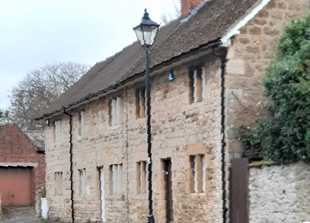
6.2 Is this a landscape-led design aimed at maintaining the existing rural character of the fields and lanes? Or is the design aiming to match the existing built environment in the Iffley Conservation Area? The current plan is unclear with regard to these questions. If the former, the design proposal does nothing to preserve the rural characteristics of the ICA. If the latter is your aim, please consider taking as your ‘local vernacular’ referent, the historic, 2-storey social housing on Church Way, built of Cotswold stone:
6.3 The visualisations on p. 7 of ‘sensitively designed’ homes that will ‘complement the existing village vernacular and Iffley Conservation Area’ bear no relation to existing buildings in the ICA, in their open, rural setting. They appear to us generic designs that could be lifted from any new suburban development, and are in no way in keeping with the character of the Iffley Conservation Area. The specific Iffley Village architectural cues that the design stems from should be articulated and the design rationale fully explained.
6.4 If there is to be departure from the local vernacular (e.g. to respond to landscape concerns by using design features to try and ‘hide’ the development), then we would expect to see imaginative use of excavation to dig homes into the slope to preserve the view from Church Way, use of green roofs, traditional street lighting, use of Cotswold stone for house facing and garden walls, rural and ragged edging within the development, as well as along Meadow Lane and Church Way, with narrow entrance ways preserved.
6.5 The proposed rooms-in-the-roof of the majority of the houses look more like three storeys than the stipulated limit of two storeys. The visualisation on p. 2 renders the roofs in a colour that blends with the sky, which seems designed to downplay the actual height of the proposed buildings. Please advise on the actual ridge heights in the plans. 2.5 storeys is not the same as 2 storeys.
6.6 On p. 8, OCHL claim, ‘We are committed to delivering a sustainable scheme and want to set the standard for new housing as the City works to tackle the climate emergency’. We welcome this commitment, but seek clarification on how the present design delivers on these words. How will all the new-builds be designed and built to minimise total energy use? Can you explain the mix of solar provision and Passivhaus design? From the printed material, it seems that only affordable homes will be built to Passivhaus energy standard. If this is the case, why?
6.7 We welcome the commitment to Passivhaus energy design but would ask why this is framed as a vague commitment rather than an objective to be achieved and confirmed through certification. Why are you not requiring certification of Passivhaus energy standard?
6.8 What specific targets are OCHL giving the builders in terms of energy consumption in the homes for heating and hot water?how will you certify that the designs will attain these targets?
6.9 The written material sets out OCHL objectives of providing affordable housing in Oxford and asserts that it takes this objective seriously while commercial developers would not do so. However, the SP42 policy for affordable housing is the same as for all developments under the Local Plan 2036, i.e. making provision for 50% affordable and social housing. The current design for this development goes no further than the minimum required in LP2036, making provision for 12 homes at social rent. Please explain how this is going further than any other commercial developer. The Masterplan (p. 5) suggests that most of the area is given over to luxury market value homes with relatively large suburban gardens. Could the developers indicate how the intended design will foster community cohesion and integration of lower and high value homes? Could OHCL confirm that the net profit from the development will be ring-fenced for affordable housing delivery elsewhere in Oxford? We were advised at the public meeting that it would merely be returned to OCC’s coffers and could thus be spent on things other than social housing. This seems wrong.
6.10 Could OCHL provide information on how the development on the Horse Fields will help address Oxford’s problems with housing affordability. Is there a target for the intended pricing across the 30 housing units? Will the average sale price across the 30 units be lower than the Oxford City average or higher?
6.11 Could OCHL indicate its proposal for how communal natural areas of the site plan will be maintained and managed given the mix of private and public holdings?
6.12 Have you calculated the carbon release of the construction process? Hill has stated a commitment to becoming a zero carbon builder by 2030. This does not provide any assurance for the zero carbon build target for this particular development proposal.
7. Lack of accuracy and coherence in public communication and consultation
7.1 We welcome the opportunity we were given to meet with the design team on 11 December. We are disappointed, however, by the incompleteness, inaccuracy and inconsistency of the information supplied by different members of the team to different members of FOIV and the general public. There are also discrepancies between what we were told by the design team and what is included in the written material. The written material itself contains numerous inaccuracies and inconsistencies from one part of the document to the next.
7.2 For example, the hedgerow at the bottom of Meadow Lane is either to be preserved, re-laid or removed, according to different sections of the document, and different statements by the design team. In the printed material, the visualisation on p. 2 of Meadow Lane is extremely misleading, suggesting a wide avenue, with new landscaped frontage and no hedgerow. This is not consistent with the description of the same, on p. 10. The extensive badger sett is either to be preserved or re-located, according to different statements, while the site plan on p. 5 sites a public footpath right through the existing sett location. The photos on p. 10 (of fritillaries, beehives, tree pits and a suburban street) appear to bear no relation to the textual description of the site plans. The half-timber buildings and traffic calming measures pictured on p. 9 appear to bear no relation to the design proposals for this site. The photo captioned ‘Iffley meadow fritillaries’ actually shows green winged orchids, a base error that suggests the PR team are making decisions on publicity material based on what they think will play well rather than what they know to be accurate. This is extremely alarming.
7.3 References to the Memorial Field in the written document (p. 11 and elsewhere) are confusing and seem to suggest that the Horse Fields development is being traded off against the Memorial Field. This is not what is stated in the Local Plan allocation of this site.
7.4 The Horse Fields and the Memorial Field are entirely separate issues. The Memorial Field should be the subject of a separate consultation. Consultation over the Memorial Field should be informed by appropriate studies and information on possible long-term institutional arrangements that will help secure its protection for the long-term.
The following application is live. Those wishing to make comment can do so using the OCC Planning portal. Use the application reference number to get to the comments box.
21/03178/FUL
Last Date for Comments 15th January
Address
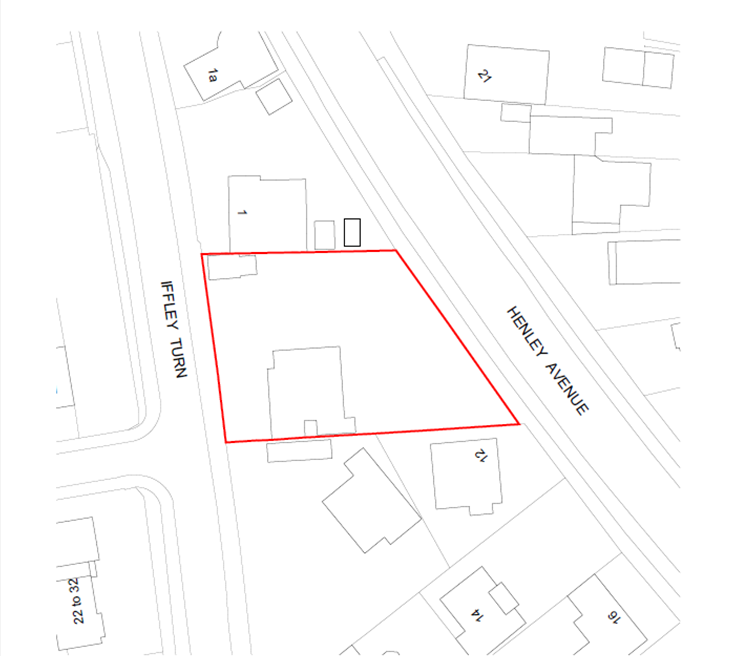
3 Iffley Turn Oxford OX4 4DU
Description
Demolition of existing dwelling house. Erection of 2 x 4 bed semi detached dwellinghouses and 1no. detached bungalow. Provision of private amenity space, bin and cycle storage.

 Horse Fields – as they are
 and as they may become…